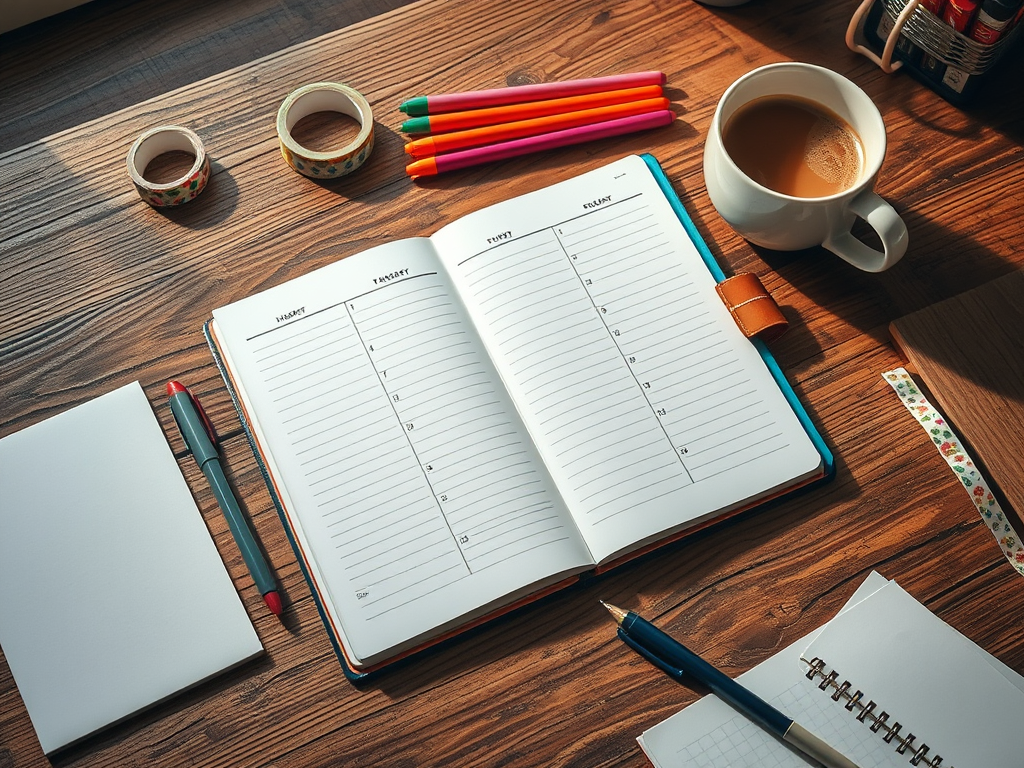
• 5 Ways to Stay Organized and Productive with Beautiful Planners

    There’s just something magical about a beautiful planner. The crisp pages, the stylish cover, the endless possibilities for organizing your life—it’s like a personal assistant in paper form. Whether you’re a busy student, a working professional, or just someone trying to juggle life’s chaos, using a planner can help you stay organized and boost your productivity. And let’s be honest: when your planner is pretty, it’s just way more fun to use.

    Here are five ways to stay on top of your game with beautiful planners, plus tips on making the most out of your new productivity tool. Spoiler alert: organization can totally be your aesthetic.


    1. Use Color Coding to Categorize Your Life

    A gorgeous planner deserves equally stunning organization. Color coding is an easy and visually satisfying way to keep track of all your commitments, projects, and goals. Grab some highlighters, markers, or pens in your favorite shades, and assign each color to a different category in your life—work, personal, fitness, hobbies, family, etc.

    For example:

    • Blue for work tasks
    • Pink for personal goals
    • Green for health-related activities like gym time or meal planning
    • Purple for social events or fun stuff

    Every time you flip through your planner, you’ll instantly know what’s happening at a glance. Plus, the rainbow of colors makes your planner feel more like art than a to-do list.

    Pro Tip: Use stickers or washi tape for an extra splash of creativity! There are tons of affordable options with cute designs that add flair to your weekly spread.

    A flat lay of a beautifully decorated planner with vibrant color-coded entries, markers, and cute stickers scattered around.

    2. Set Weekly Goals and Priorities

    One of the best ways to stay productive is to start every week with clear goals. At the beginning of the week, dedicate 10-15 minutes to mapping out your top priorities in your planner. This step keeps you focused and ensures that you’re working toward things that actually matter to you.

    Here’s how:

    • Write a short list of your must-do tasks for the week.
    • Add a small section for your nice-to-dos—things you’d like to accomplish but aren’t dealbreakers.
    • Include personal goals, like “drink 8 glasses of water a day” or “read for 20 minutes before bed.”

    Many planners come with sections for goals or habit tracking, so take advantage of those! If yours doesn’t, you can create your own system by dedicating a corner of your page to jotting down your weekly targets. The key here is to keep it manageable—you’re trying to reduce stress, not add more.

    Close up shot of planner pages showing GOALS section

    3. Use the Monthly Layout for Big Picture Planning

    The monthly spread in your planner is your secret weapon for staying organized. While the weekly or daily pages focus on immediate tasks, the monthly layout lets you see the big picture. Use this section to map out key dates, deadlines, and events.

    Here’s what to include in your monthly overview:

    • Work deadlines
    • Important appointments
    • Birthdays, anniversaries, or holidays
    • Project timelines
    • Personal milestones (e.g., finishing a course, completing a book)

    Keeping everything in one place means you’ll never forget that deadline or double-book yourself again. Plus, this bird’s-eye view of your month helps you plan ahead and avoid last-minute stress.

    Pro Tip: Try adding a motivational theme for each month. For instance, January could be your “Fresh Start” month, while October could focus on “Balance and Rest.”

    Monthly planner page filled with information

    4. Incorporate Time Blocking into Your Planner

    Time blocking is an absolute game-changer when it comes to productivity. This technique involves breaking your day into chunks of time dedicated to specific activities. It’s like scheduling an appointment with yourself for deep work, self-care, or even leisure time.

    Here’s how to do it with your planner:

    1. Use the hourly layout (or draw your own timeline if your planner doesn’t have one).
    2. Assign blocks of time for your tasks, like:
      • 9:00 AM – 11:00 AM: Work on client project
      • 12:00 PM – 1:00 PM: Lunch and walk
      • 1:30 PM – 3:00 PM: Study or work on a course
      • 4:00 PM – 5:00 PM: Catch up on emails

    This structure helps you avoid multitasking (the productivity killer) and ensures that you’re giving full focus to each part of your day. Plus, it’s incredibly satisfying to see a well-structured day laid out in your planner.

    Pro Tip: Don’t forget to block out time for rest and self-care. Breaks are just as important as work sessions for keeping your energy high.

    A planner page with neatly labeled time blocks and a mix of work and personal activities, accompanied by a coffee cup or cozy ambiance.

    5. Make It a Ritual with a Planner Check-In

    Your planner isn’t just a tool—it’s a ritual. Taking time each day to check in with your planner creates a mindful moment where you can focus on what’s important. It’s not just about staying organized; it’s about setting intentions for your day.

    Here’s a simple routine to follow:

    1. Morning: Start your day with a quick glance at your planner. Review your tasks and prioritize the top 1-3 things you need to accomplish.
    2. Evening: Before bed, spend a few minutes reviewing what you got done, moving unfinished tasks to the next day, and planning tomorrow.

    These check-ins give you clarity and help you feel in control of your schedule. Plus, they’re a great opportunity to reflect and appreciate how much you’ve accomplished—yes, even the little things count!

    Pro Tip: Pair your planner time with something soothing, like a cup of tea, a candle, or some relaxing music. This creates a positive association with the process, making it feel less like a chore and more like self-care.

    A cozy desk setup with a planner, a candle burning in the background, and a mug of tea or coffee next to it

    Choosing the Perfect Beautiful Planner for You

    Now that you know how to maximize your planner, let’s talk about finding the perfect one. There are so many options out there that it can be overwhelming, but here are a few tips to guide you:

    1. Decide on a Layout: Do you prefer daily, weekly, or monthly spreads? Some planners offer a mix, so choose one that suits your planning style.
    2. Consider Size: Are you carrying it everywhere? A smaller, lightweight planner is ideal for on-the-go use, while larger planners are great for detailed planning at home.
    3. Pick a Design You Love: From sleek and minimalist to floral and artsy, there’s a planner for every vibe. When you love how it looks, you’ll be more motivated to use it.
    4. Look for Extras: Some planners come with habit trackers, gratitude logs, or even inspirational quotes—these little extras can make your planning experience even more enjoyable.
    A display of different planner styles, ranging from minimalist leather-bound ones to colorful, patterned designs with fun accessories like pens and washi tape.

    Wrapping It Up

    Staying organized and productive doesn’t have to feel like a chore, especially when you’re using a beautiful planner. With a little creativity and intention, your planner can become a tool that not only helps you tackle your to-do list but also brings joy to your daily routine. From color coding and goal setting to time blocking and monthly overviews, these strategies will keep you on track—and make your life look a whole lot prettier while you’re at it.

    So, grab your favorite planner, some colorful pens, and start organizing your way to a more productive (and stylish) life. You’ve got this!

    Image Suggestion: A final, inspirational shot of an open planner on a sunny desk, surrounded by flowers, pens, and a motivational quote like “Plan your dreams into reality.”

    Plan your dreams into reality


    Thanks for stopping by!

    What do you think? Are you ready to organize your life with a beautiful planner? Let me know in the comments if you have any other tips or favorite planner brands to share!

  • Ever feel like the day just slips away? You start with grand plans to be productive, but by the end of the day, your to-do list is untouched, and you’re wondering where all that time went. We’ve all been there. The truth is, managing your time isn’t about squeezing more into your day—it’s about making the most of the time you already have.

    In this post, we’ll break down some practical time management hacks to help you get things done, stay focused, and, most importantly, feel in control of your day. Let’s dive in!


    1. The Two-Minute Rule: Start Small, Finish Fast

    The two-minute rule is a game-changer for those tiny tasks that clutter your day. Here’s how it works: if a task will take less than two minutes to complete, do it immediately. Whether it’s responding to an email, loading the dishwasher, or jotting down a quick idea, don’t let those micro-tasks pile up.

    Why it works:
    Small tasks have a way of lingering in the back of your mind, distracting you from bigger projects. Clearing them quickly frees up mental space and gives you a small sense of accomplishment to build momentum.

    Pro Tip: Pair this with a “quick wins” list—a section in your planner where you jot down these short tasks.

    A timer app on a smartphone with a “2:00” countdown, next to a completed checklist on a desk.

    2. Time Blocking: Your Calendar Is Your Boss

    Time blocking is one of the most effective ways to take control of your day. It’s simple: divide your day into blocks of time, and assign each block to a specific task or category.

    For example:

    • 8:00 AM – 9:00 AM: Respond to emails
    • 9:00 AM – 11:00 AM: Deep work (focus on a big project)
    • 12:00 PM – 1:00 PM: Lunch and relaxation
    • 1:30 PM – 3:00 PM: Meetings or calls

    Why it works:
    By assigning every task a “home” in your schedule, you eliminate decision fatigue and stay laser-focused. Plus, when you look at your calendar, you’ll instantly know what to work on next—no more procrastination or aimless scrolling.

    Pro Tip: Use digital tools like Google Calendar or apps like Notion to create color-coded time blocks for work, personal tasks, and self-care.

    A colorful time-blocked planner or Google Calendar displayed on a laptop screen with a coffee cup beside it.

    3. The Pomodoro Technique: Work Smarter, Not Longer

    The Pomodoro Technique is a productivity method that breaks your work into focused intervals, usually 25 minutes, followed by a 5-minute break. Here’s how to do it:

    1. Choose a task to work on.
    2. Set a timer for 25 minutes.
    3. Work on the task until the timer rings.
    4. Take a 5-minute break.
    5. Repeat, and after 4 Pomodoros, take a longer 15-30 minute break.

    Why it works:
    Short bursts of focus help you avoid burnout and keep procrastination at bay. Plus, knowing you only have to work for 25 minutes at a time makes even the most daunting tasks feel manageable.

    Pro Tip: Use a dedicated Pomodoro timer app like Forest or Focus Booster to keep things fun and track your progress.

    A simple tomato-shaped timer (the inspiration for "Pomodoro") sitting next to a laptop and notebook.

    4. Tackle Your MITs (Most Important Tasks) First

    Ever notice how your energy and focus are at their peak in the morning? That’s why it’s crucial to tackle your MITs—your Most Important Tasks—first thing in the day. These are the tasks that have the biggest impact on your goals or deadlines.

    How to identify your MITs:

    • At the start of each day, write down 1-3 tasks that absolutely need to get done.
    • Prioritize them above everything else, even before checking emails or attending to smaller tasks.

    Why it works:
    By focusing on what matters most when you’re fresh and energized, you ensure that your day starts on a productive note. Everything else becomes a bonus.

    Pro Tip: Limit your MITs to no more than 3 items—it’s about focusing, not overwhelming yourself.

    A handwritten list titled “Top 3 Priorities” with one task checked off, surrounded by motivational desk accessories.

    5. Batch Similar Tasks Together

    Task batching is all about grouping similar activities and tackling them in one go. For instance:

    • Answering emails all at once instead of checking your inbox every 10 minutes.
    • Scheduling all your meetings back-to-back instead of spreading them throughout the day.
    • Running errands in one trip instead of multiple outings.

    Why it works:
    Switching between tasks (aka “context switching”) wastes a ton of time and mental energy. When you batch similar activities, you stay in the same mindset and get things done faster.

    Pro Tip: Create themed days if possible. For example, dedicate Mondays to planning, Tuesdays to deep work, and Fridays to admin tasks.

    A workspace with open tabs on a computer screen showing "Email Hour" or "Meeting Prep" next to a planner with a clearly labeled schedule

    6. Say No More Often

    One of the most underrated time management hacks? Learning to say no. Whether it’s turning down a meeting that doesn’t need your input or declining a new project that conflicts with your priorities, protecting your time is essential.

    How to say no gracefully:

    • Be polite but firm: “Thanks for thinking of me, but I can’t take this on right now.”
    • Offer alternatives: “I’m not available, but maybe [colleague] could help?”
    • Set boundaries: “I can only attend if we keep it under 30 minutes.”

    Why it works:
    Every “yes” to something unimportant is a “no” to something that matters. Saying no allows you to stay focused on your goals and priorities.

    Pro Tip: If you struggle with saying no, rehearse a few go-to responses so you’re ready when the time comes.

    A desk with a sticky note that reads “Protect Your Time” in bold letters, surrounded by office supplies

    7. Automate and Delegate Wherever Possible

    You don’t have to do everything yourself. Look for tasks that can be automated or delegated to free up your time for higher-value activities.

    Ideas for automation:

    • Use apps like Zapier to automate repetitive tasks like sending reminders or updating spreadsheets.
    • Schedule bill payments and subscriptions so you never have to think about them.

    Ideas for delegation:

    • At work, delegate routine tasks to team members when possible.
    • At home, share chores with family members or use services like grocery delivery.

    Why it works:
    By removing low-priority tasks from your plate, you can focus on what only you can do, like strategic thinking or creative work.

    Pro Tip: Even small automations—like saving templates for emails—add up to big time savings over weeks or months.

    A smartphone screen showing an automation app or a task list with some items marked “delegated.”

    8. Limit Your To-Do List to 5 Items

    Raise your hand if you’ve ever written a mile-long to-do list, only to feel completely overwhelmed by it. The solution? Keep your daily to-do list short—no more than 5 key tasks.

    Why it works:
    A shorter list forces you to prioritize and prevents that crushing feeling of “I’ll never finish everything.” Plus, when you actually do finish your list, it’s incredibly motivating.

    Pro Tip: If you’re someone who needs to write down everything, create a “master list” elsewhere and pull only 3-5 items from it each day.

    A planner or notepad with a short to-do list, with 4 out of 5 tasks checked off.

    9. Set Clear Boundaries for Focus Time

    Distractions are the ultimate time thieves. To truly make every second count, you need dedicated focus time where interruptions are off-limits.

    How to create focus time:

    • Turn off notifications on your phone or use “Do Not Disturb” mode.
    • Let coworkers or family know you’re unavailable during this time.
    • Use noise-canceling headphones or play focus-friendly background music.

    Why it works:
    Distractions pull you out of your flow state, making even simple tasks take twice as long. By protecting your focus time, you can power through your to-do list without constantly losing momentum.

    Pro Tip: Block out focus time on your calendar and treat it like a non-negotiable appointment.

    A desk with a phone face-down, headphones on top of a laptop, and a sticky note that reads “Focus Time in Progress.”

    10. Reflect and Plan for Tomorrow

    One of the best ways to manage your time effectively is to end each day with a quick reflection. Take 5-10 minutes to review what you accomplished, what didn’t get done, and what you need to focus on tomorrow.

    Why it works:
    Reflecting gives you closure for the day and helps you start tomorrow with a clear game plan. You’ll spend less time wondering “What should I do next?” and more time actually getting things done.

    Pro Tip: Pair this with gratitude journaling for a positive end to your day. Write down 1-2 things you’re proud of or thankful for.

    A journal or planner open to a page titled “Daily Reflection,” with a pen and a cup of tea next to it.

    Wrapping It Up

    Time management isn’t about working harder—it’s about working smarter. By using these hacks, you’ll not only improve your productivity but also create more time for the things you love. From time blocking and the Pomodoro Technique to saying no and setting boundaries, each tip is designed to help you make every second count.

    Start with just one or two of these strategies and build from there. Remember, small changes lead to big results over time. Here’s to reclaiming your time and making the most of every moment!


    What’s your favorite time management hack? Let me know in the comments, and don’t forget to share this with someone who could use a little extra time in their day!

  • Why Physical Planners Are Making a Comeback in a Digital World

    In an era where our smartphones are essentially glued to our hands and productivity apps promise to simplify our lives, physical planners are quietly sneaking back into the spotlight. It seems counterintuitive—why would anyone lug around a chunky notebook when they could have everything neatly organized in their pocket? But here’s the thing: physical planners offer something that digital tools often lack—a sense of mindfulness, creativity, and, dare I say, joy.

    So, let’s break it down. Why are people shelving their Google Calendars and Notion boards in favor of good old-fashioned pen and paper? Let’s dive into this modern-day paradox and see why physical planners are making such a powerful comeback in a digital world.


    1. The Tactile Satisfaction of Writing Things Down

    There’s something deeply satisfying about putting pen to paper. That subtle resistance when the pen glides over the page? It’s oddly therapeutic. Studies have shown that writing by hand helps you retain information better and engage more deeply with what you’re working on. When you write something down, it’s like telling your brain, “Hey, this matters.”

    Typing into a phone or laptop, while efficient, can feel detached. Physical planners tap into this tactile satisfaction. You’re not just jotting down tasks—you’re creating an experience. The act of writing turns planning from a chore into a ritual. And for many, that’s reason enough to go analog.

    A flat lay of a beautifully designed planner surrounded by colorful pens, washi tape, and maybe a coffee cup, evoking a cozy, creative vibe.

    2. Escaping Digital Overload

    Let’s be real: our devices are a double-edged sword. They’re amazing for staying connected, but they’re also a breeding ground for distractions. How many times have you opened a productivity app only to end up doom-scrolling Instagram or TikTok?

    Physical planners offer a digital detox. They’re a space where you can focus without the constant ping of notifications. Want to plan your week without falling into a YouTube rabbit hole? A paper planner doesn’t come with pop-ups or Wi-Fi. It’s blissfully simple—just you, your pen, and your thoughts.

    A serene desk setup with a planner, a plant, and a phone turned upside down in the background, symbolizing unplugging.

    3. Personalization and Creativity

    One of the coolest things about physical planners is how customizable they are. With digital apps, you’re stuck with whatever design and layout the developer chose. But with a paper planner, the world is your oyster. Love bullet journaling? Go wild with grids and dotted pages. Prefer pre-printed calendars and goal-setting templates? Tons of options are out there.

    And then there’s the creative side. Many planner enthusiasts turn their pages into works of art, using calligraphy, stickers, and doodles to bring their schedules to life. It’s not just about organizing your life—it’s about expressing yourself. This creative freedom is a big draw for people who find digital tools too sterile and impersonal.

    A bullet journal open to a beautifully decorated weekly spread, complete with hand-drawn doodles and stickers.

    4. A Moment of Mindfulness

    In a world that’s always go-go-go, using a physical planner can be a surprisingly grounding experience. Taking a few minutes each morning to plan your day or reflect on your goals forces you to slow down and be present. It’s like hitting the pause button on a chaotic life.

    Mindfulness experts often recommend writing as a way to clear your head and focus your thoughts. Physical planners naturally lend themselves to this practice. Many planners even come with built-in mindfulness prompts, gratitude sections, or reflection pages. This isn’t just organization—it’s self-care.

    A person sitting by a sunny window, writing in a planner with a peaceful expression, perhaps with a cup of tea nearby

    5. Building a Tangible Record of Your Life

    There’s something uniquely nostalgic about flipping through an old planner. Unlike a digital calendar that disappears into the ether, a physical planner becomes a keepsake. It’s a tangible record of your life—your highs, your lows, your to-do lists that you may or may not have completed.

    Years down the line, you can look back at your planner and see what you were doing, thinking, or dreaming about. It’s like a mini time capsule. And in a world that’s increasingly digital, having something physical to hold onto feels deeply meaningful.

    Image Suggestion: A stack of well-loved planners, showing signs of wear and tear, with handwritten notes visible on the pages.


    6. The Aesthetic Appeal

    Let’s not ignore the fact that physical planners are just…pretty. The planner market has exploded with gorgeous designs, from minimalistic leather-bound journals to vibrant, colorful covers that scream personality. Carrying around a planner can feel like a style statement, adding a touch of elegance or whimsy to your daily routine.

    Meanwhile, digital apps, no matter how functional, just don’t have the same vibe. There’s nothing particularly inspiring about a list of tasks on a screen. But a well-designed planner? That sparks joy.

    Close-up of an elegant planner with gold-embossed lettering on the cover, lying next to a matching pen and other chic accessories

    7. Accountability and Commitment

    When you write something down in a planner, it feels more official. There’s a sense of commitment that comes with putting pen to paper. It’s like you’ve made a promise to yourself to get it done.

    Digital tools, on the other hand, make it all too easy to delete, reschedule, or simply forget about tasks. A physical planner stares back at you, unapologetically holding you accountable. For people who struggle with follow-through, this tangible accountability can make all the difference.

    A planner open to a weekly layout with checkmarks next to completed tasks, symbolizing productivity and progress.

    8. The Community Factor

    Believe it or not, there’s a whole community around physical planners. From Instagram accounts to YouTube channels, people love sharing their setups, tips, and creative ideas. It’s a hobby as much as it is a tool for organization.

    Being part of this community can be incredibly motivating. Whether you’re swapping sticker recommendations or showing off your latest layout, there’s something inspiring about connecting with others who share your passion for planning. And let’s face it, you’re not likely to find the same kind of fandom around Google Calendar.

    Table full of planner supplies

    9. It’s Not an Either/Or Situation

    Here’s the thing: using a physical planner doesn’t mean you have to ditch digital tools altogether. Many people find that the best system is a hybrid one. You might use Google Calendar for appointments and deadlines while relying on a physical planner for day-to-day tasks, goal setting, and creative planning.

    The key is finding what works for you. The resurgence of physical planners isn’t about rejecting technology—it’s about adding balance. Sometimes, you need the convenience of digital tools. Other times, you crave the simplicity and mindfulness of pen and paper. Why not have both?


    Final Thoughts

    In a world dominated by screens, the return of physical planners feels like a breath of fresh air. They offer something uniquely human in a sea of algorithms and automation—a chance to slow down, reflect, and take control of your time in a way that feels meaningful.

    Whether you’re a lifelong fan of paper planning or just curious about giving it a try, there’s never been a better time to embrace the analog life. Who knows? That little planner might just become your favorite tool in this ever-digital world.


    Thanks for Stopping By!

    Click HERE to see a selection of physical planners!

  • The History of the Written Word: From Scrolls to Modern Stationery

    The written word is one of humanity’s greatest achievements, a cornerstone of culture, communication, and civilization itself. From the earliest etchings on stone tablets to the sleek, modern stationery we use today, the history of writing materials tells the story of human innovation and creativity.

    Let’s embark on a journey through time, exploring how writing evolved from ancient scrolls to the modern tools we use to jot down thoughts, craft letters, or organize our lives.


    The Dawn of Writing: Carving Ideas in Stone

    Long before pens and paper, early humans found ways to record information using the materials around them. The first “writing” systems, like cuneiform in ancient Mesopotamia (circa 3100 BCE), were etched into clay tablets using sharp tools. These clay tablets were then baked in the sun, preserving early records of trade, taxes, and laws.

    Meanwhile, in ancient Egypt, the hieroglyphics that adorned temples and tombs were carved into stone walls, serving as both artistic and informational records. Though durable, stone and clay were bulky and impractical for long texts, prompting the search for more portable alternatives.


    Scrolls: The Birth of Portability

    Around 3000 BCE, the Egyptians began crafting a revolutionary writing material: papyrus. Made from the pith of the papyrus plant, this lightweight, flexible material could be cut into sheets and glued together to form scrolls.

    Papyrus scrolls quickly became the dominant medium for writing in Egypt, Greece, and Rome. They were used for everything from religious texts to administrative records, allowing knowledge to spread more easily than ever before.

    However, papyrus was fragile and difficult to produce in large quantities. This paved the way for other materials, like parchment and vellum, which were made from animal skins and proved far more durable.

    A rolled-up papyrus scroll with faint hieroglyphic text, placed next to a quill pen.

    The Codex: A Revolutionary Leap

    By the 1st century CE, a new format began to emerge: the codex, a precursor to the modern book. Unlike scrolls, codices consisted of flat sheets bound together along one edge. This design made codices easier to handle, store, and reference compared to unwieldy scrolls.

    The transition from scrolls to codices marked a monumental shift in the way information was accessed and shared. Early codices were often made of vellum or parchment, prized for their durability and smooth writing surface. Monks in medieval Europe painstakingly copied religious texts onto these materials, creating beautifully illuminated manuscripts that were both works of art and vessels of knowledge.

    A richly decorated medieval manuscript, open to show colorful illustrations and text written on vellum.

    The Paper Revolution

    While parchment and vellum dominated the West, paper was transforming the East. Invented in China during the Han Dynasty (around 105 CE), paper was made from a pulp of mulberry bark, hemp, and rags. It was cheaper and more versatile than its predecessors, sparking a revolution in written communication.

    Paper spread to the Islamic world by the 8th century and to Europe by the 12th century. By the 15th century, the invention of the printing press by Johannes Gutenberg paired with mass-produced paper transformed the written word into something accessible to the masses. Books, pamphlets, and letters could now be created at an unprecedented scale.

    An ancient Chinese scholar writing on a scroll of handmade paper, with brushes and ink by their side.

    The Rise of Stationery: Personalized Writing Tools

    As paper became more common, so did tools for personal writing. By the 18th and 19th centuries, stationery sets with letter paper, envelopes, and wax seals became symbols of refinement and sophistication.

    • Quills and Ink: Until the 19th century, the quill pen, made from bird feathers, was the standard writing tool. These were replaced by steel nib pens, which were more durable and consistent.
    • Fountain Pens: Invented in the early 19th century, fountain pens provided a smoother, more elegant writing experience and became an essential part of professional and personal correspondence.

    Stationery wasn’t just functional—it was also artistic. Engraved letterheads, monogrammed paper, and ornate seals added a personal touch, turning letters into cherished keepsakes.

    A Victorian-era stationery set, complete with a fountain pen, wax seal, and monogrammed paper.

    The Modern Era: The Convenience of Writing

    The 20th century saw a boom in writing innovations. From the invention of ballpoint pens in the 1930s to the rise of sticky notes in the 1970s, tools for writing became increasingly practical and accessible.

    At the same time, stationery transformed into a creative medium. Beautifully designed notebooks, colorful pens, and artistic greeting cards reflected the growing popularity of journaling, scrapbooking, and personalized correspondence.

    Today, digital tools like tablets and laptops dominate communication, but traditional stationery continues to thrive as a tactile, personal experience. The rise of premium brands like Moleskine and Midori shows that people still value the simple pleasure of putting pen to paper.

    A desk with modern stationery items: a sleek notebook, colorful gel pens, and sticky notes, next to a tablet or smartphone.

    Why the Written Word Still Matters

    From its humble beginnings on stone tablets to the artistic expression of modern stationery, the written word has always been about more than just communication. Writing preserves knowledge, expresses emotion, and connects us across time and space.

    Even in the digital age, there’s something uniquely meaningful about handwriting a letter, journaling in a beautiful notebook, or sending a thoughtfully chosen card. It’s a reminder of our shared history and the enduring power of words to inspire, comfort, and connect.

    A hand holding a pen, writing in a journal surrounded by a mix of ancient scrolls and modern stationery, symbolizing the evolution of the written word.

    Final Thoughts

    The journey of the written word—from stone tablets to stationery—reflects the progress of humanity itself. Each step in its evolution has brought us closer together, allowing us to share ideas, emotions, and creativity in new and meaningful ways.

    So, the next time you pick up a pen or open a notebook, take a moment to appreciate the incredible history behind these simple tools. They’re more than just objects—they’re the culmination of thousands of years of innovation, storytelling, and connection.


    Thanks for Stopping By!

    What’s your favorite way to write—on paper, digitally, or a bit of both? Let me know in the comments below!